
GLP-1s, brain health and the workplace: are we measuring the right return?
Following a flurry of conversations and news coverage such as the ones about Bank of America over the past couple of weeks, I’ve been digging into the economics of GLP-1s for employers and the more I look at the data, the more I think we may be asking the wrong question.
Instead of focusing on cost (as let’s face it most companies still focus on cost reductions in relation to health), we should ask the question: could GLP-1s have a positive effect on both health and cognitive performance?
The (not yet so strong) GLP-1 business case for impact on performance and productivity
The majority of business cases to date focus on healthcare savings: invest in GLP-1s today and, as people become healthier, medical costs should come down tomorrow. It’s an attractive argument. The problem is that the numbers don’t quite support it, yet, and in the short-term.
Aon has been following GLP-1 users against matched controls, and there is a genuinely encouraging signal. Take away the cost of the medication and medical expenditure starts to converge towards the control group. GLP-1s appear to be bending the medical cost curve. But put the cost of the drug back in and total expenditure remains materially higher. Aon’s latest analysis of 192,000 GLP-1 users points in the same direction. At today’s prices, the medication still costs more than the medical savings it creates.
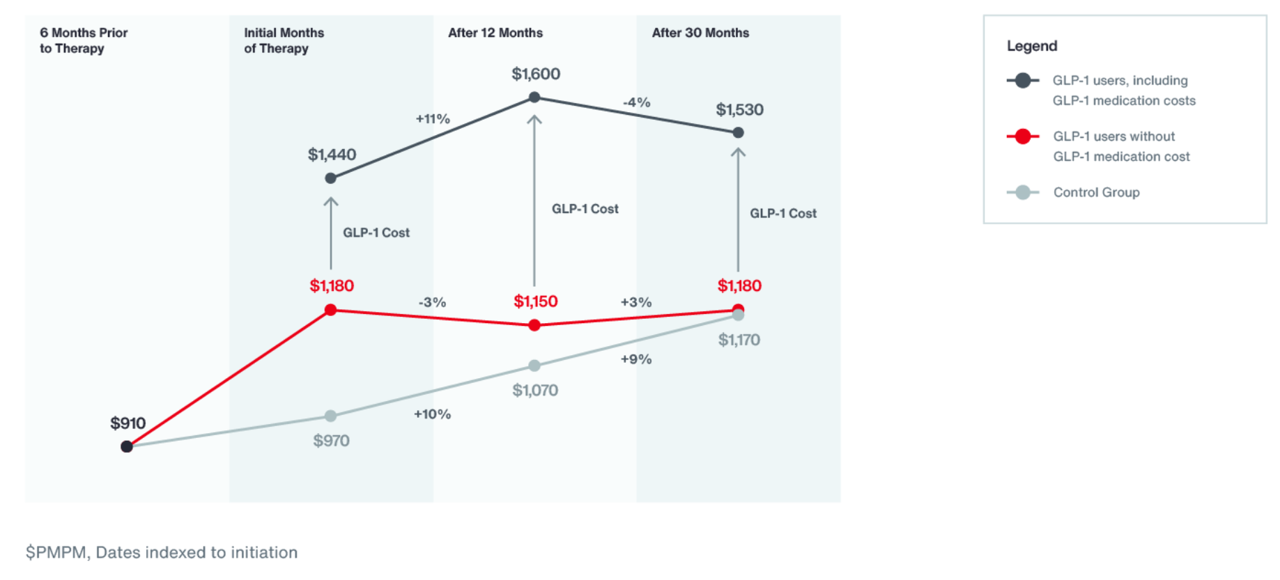
So, I wouldn’t walk into a CFO’s office and say: “Pay for GLP-1s and your healthcare costs will fall.” The evidence isn’t there, yet. However, employers don’t just pay for healthcare, they also pay for sick absence, incidents and lost productivity, and this is where it starts to become interesting.
Obesity has been associated with around 3 additional sick days per year, with estimated productivity losses of $271–$542 per employee with obesity annually. A new 2026 NBER (National Bureau of Economic Research) study using Danish administrative data has found that starting GLP-1 treatment reduced long-term sickness absence by 17.3%. For employers, that is a significant finding because suddenly we are moving beyond weight loss and medical claims and into an outcome that directly affects the workplace.
But, there is a but. The researchers did not find evidence that this translated into employees earning more, becoming more likely to be employed, or participating more in the labour markets. So, we are beginning to see evidence that GLP-1s may help people be at work more often, but we still don’t know whether they help people perform better when they are there. And to me, that is the much more interesting question.
There are other clues in the data. Among people taking GLP-1s for diabetes, Aon found a 6-percentage-point improvement in medical-spend growth versus matched controls between months 12 and 30. Among people with 80%+ adherence, that improvement reached 9 percentage points. That suggests the ROI may depend as much on who receives treatment, whether they stay on it and what employers actually pay for the medication as on the decision to cover GLP-1s in the first place.
Right now, GLP-1 coverage looks more like a health investment, and even as good as it might sound, let’s face it, no banker will stick to the ‘‘health investment only’’ statement for very long.
Thus, when looking at outcomes and impact, companies must expand focus beyond GLP-1.
Brain capital can help changing focus and ROI
We need to move beyond ‘‘medical cost should lead to lower healthcare cost’’ and this is where brain health and brain capital can help inform the transition towards cognitive health and performance: a medical investment leads to better health, lower medical-cost, fewer sick days (absence), better cognitive function (presence), better individual and company performance (outcome and impact).
Only once cognitive potential and productivity are included in the final calculations, only then will the business case start to make sense and ultimately stick.
We’re beginning to uncover whether GLP-1s can help people be at work. What I really want to understand next is whether they can help people to also perform better at work. Because those are two very different things.
Written by Linda Jarnhamn, Founder & CEO of flow2thrive.