
Measuring Cognitive Performance at Scale
If (as we've argued in a previous article) the existing measures for performance are no longer enough, then next question for any leader is unavoidable:
How can cognitive performance be measured in a way that leads to better decisions, outcomes and value rather than simply generating another set of employee metrics?
For many organisations, this is where otherwise promising ideas begin to lose momentum. Conceptual frameworks often explain what leaders should pay attention to, but offer little guidance on how those concepts can be translated into everyday management practice.
As we’ve already discussed, organisations already invest considerable time and effort collecting workforce data. Annual engagement surveys, wellbeing assessments, pulse surveys and productivity metrics all provide useful information, yet very few of these instruments were designed to answer a deceptively simple question:
Are the cognitive conditions that enable high performance actually present?
The distinction is important. Most existing organisational measures describe outcomes. Whilst these measures remain valuable, they are inherently retrospective. They reveal what has already happened rather than explaining the conditions that made those outcomes more or less likely.
The challenge therefore is not a lack of organisational data. If anything, organisations are overwhelmed by data. The real challenge is the absence of meaningful cognitive intelligence; information that explains whether people have the cognitive resources, clarity and capacity required to perform effectively before performance begins to decline.
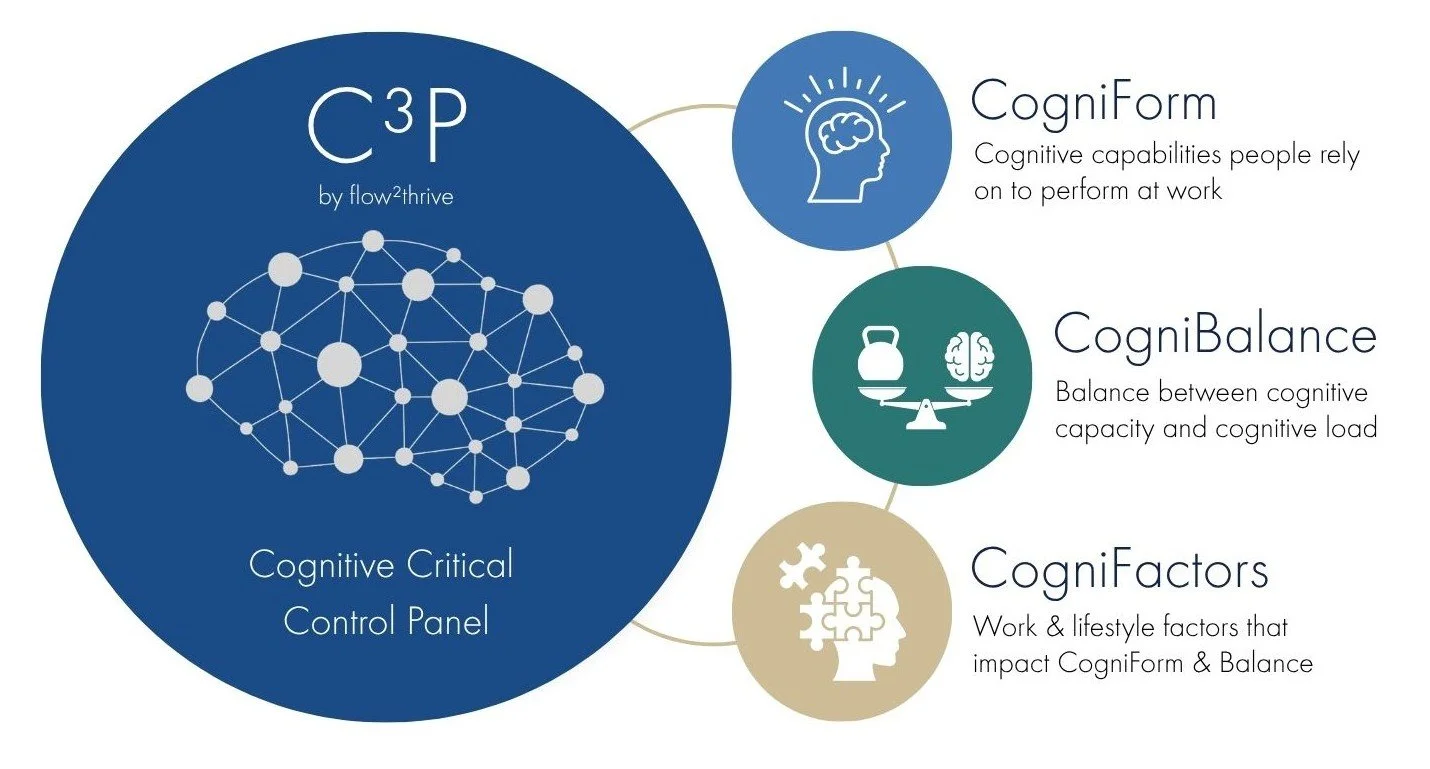
This is precisely the role of the flow²thrive Cognitive Critical Control Panel (C³P).
C³P was developed as an organisational operational measurement system for mapping cognitive performance potential and risk.
In the same way that financial dashboards allow executives to monitor organisational health or operational dashboards allow manufacturing leaders to monitor production systems, C³P provides a structured view of the cognitive conditions under which work is being performed.
Its purpose is not to evaluate individuals, but to make the cognitive system of the organisation visible. This distinction fundamentally changes what measures are used. Traditional surveys ask employees how they feel. C³P asks a different question:
What cognitive conditions currently exist, and how are those conditions influencing performance?
The objective is to generate actionable insight into the interaction between work, people and the environment in which they operate. To achieve this, the framework measures cognitive performance across three complementary domains.
CogniForm
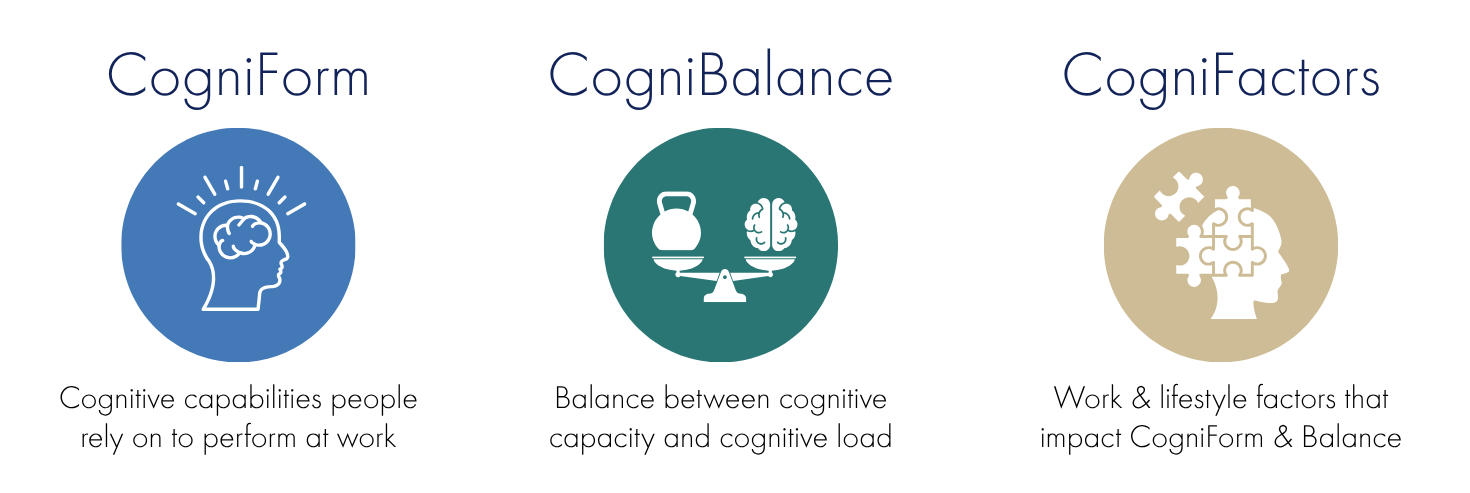
Understanding cognitive balance, however, represents only part of the picture. Leaders also need to understand how effectively people are able to perform whilst experiencing those conditions. Thus, rather than measuring personality traits or intellectual ability, CogniForm focuses on the execution of critical cognitive capabilities required for effective performance, such as critical thinking, working memory, situational awareness, attention control and decision-making.
CogniBalance
Provides an understanding of an individual's, or team's current cognitive operating state by assessing the relationship between Demand, Effort, Stretch, Clarity, Stress and Energy. Together these six levers reveal whether people are experiencing sustainable performance, productive growth, cognitive overload or underload. Importantly, the framework does not assume that more is always better. High demand can be productive when balanced by sufficient energy and clarity. Similarly, low stress is not automatically desirable if it reflects a lack of meaningful challenge. Balance, rather than maximisation, is the objective.
CogniFactors
The third domain, CogniFactors, identifies work and lifestyle factors and conditions that shape cognitive performance. Decades of research have demonstrated that factors such as sleep, recovery, nutrition, interruptions, environmental conditions and work design all influence the brain's ability to process information effectively. These variables are often considered separately within organisations, appearing in wellbeing initiatives or health programmes. C³P brings them together as measurable drivers of cognitive performance.
One of the greatest advantages of this integrated approach is that it allows organisations to observe patterns rather than isolated events.
Continuous tracking revealing invisible trends
Cognitive performance is inherently dynamic. It changes across the day, across projects and across different phases of organisational change. A single measurement provides only a snapshot of a much larger picture. Regular and repeated observations, however, can start to reveal trends that are often invisible to conventional organisational metrics.
Leaders can identify departments where cognitive effort has steadily increased despite stable workloads, recognise that clarity consistently declines during periods of organisational restructuring or observe that certain teams maintain exceptionally high performance because their cognitive energy remains protected despite increasing demands.
These insights allow interventions to occur before declining performance becomes visible in customer outcomes, operational failures or employee wellbeing statistics.
A new way to think about performance
Ultimately, this represents a shift in how organisations think about performance itself. Financial performance is managed through financial systems. Operational performance is managed through operational systems. As work becomes increasingly knowledge-intensive and AI continues to reshape the nature of work, cognitive performance will require the same level of management discipline.
CogniBalance provides the conceptual framework for understanding how cognitive performance emerges, whilst C³P provides the measurement system that enables organisations to monitor, interpret and continuously improve the cognitive conditions that determine long-term performance.
In the next article we will dig deeper into the meaning and components of CogniBalance.